Marketing Funnel Strategy for Service Businesses
Most service businesses struggle with one major problem: inconsistent leads. One month is busy, the next is slow.
The solution is not more random marketing. It is a structured marketing funnel strategy that guides potential customers from awareness to conversion in a predictable way.
A proper funnel turns your marketing into a system instead of guesswork.
What Is a Marketing Funnel Strategy
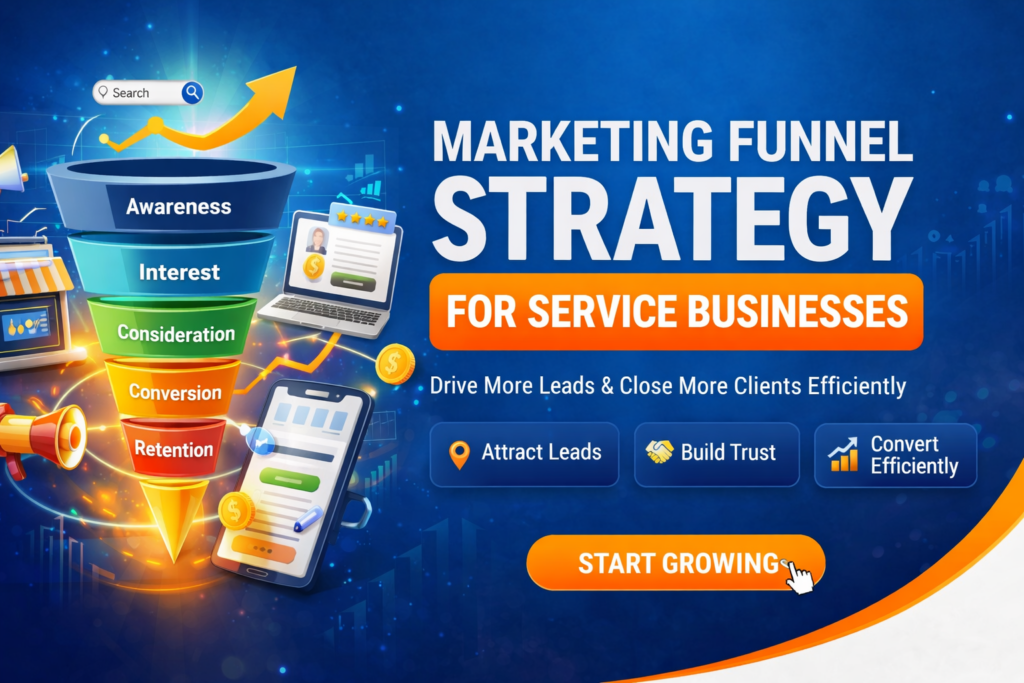
A marketing funnel strategy is a step-by-step process that moves a potential customer through different stages until they become a paying client.
For service businesses, this usually includes:
- Awareness
- Interest
- Consideration
- Conversion
- Retention
Each stage requires different messaging and channels.
Why Service Businesses Need a Funnel
Unlike product-based businesses, service businesses rely heavily on trust and decision-making.
Your customer does not buy instantly. They:
- Research
- Compare options
- Evaluate credibility
- Then decide
A funnel ensures you stay visible and relevant during this process.
The 5 Stages of a High-Converting Marketing Funnel
1. Awareness Stage
This is where potential customers discover your business.
Channels to use:
- SEO and blog content
- Social media posts
- Paid ads
- Video content
Goal: Get attention and traffic
Example:
Someone searches “website design for small business” and lands on your blog.
2. Interest Stage
Now the user knows you exist. The next step is to build interest.
What works here:
- Educational content
- Lead magnets
- Free resources
- Case studies
Goal: Keep them engaged
Example:
Offer a free guide like “10 ways to improve your website conversions.”
3. Consideration Stage
At this stage, the user is evaluating options.
Key elements:
- Testimonials
- Portfolio
- Service pages
- Comparison content
Goal: Build trust and authority
Pro Tip:
Add real results, not just claims.
4. Conversion Stage
This is where leads turn into clients.
What drives conversions:
- Clear call-to-action
- Landing pages
- Simple contact forms
- Fast response time
Goal: Close the deal
Example CTAs:
- Book a consultation
- Get a quote
- Schedule a call
5. Retention Stage
Most businesses ignore this stage, but it is where real growth happens.
Focus on:
- Follow-ups
- Email marketing
- Upselling services
- Client relationship management
Goal: Turn clients into repeat customers
Step-by-Step Funnel Strategy for Service Businesses
Step 1: Define Your Offer Clearly
You must be very clear about:
- What service you provide
- Who it is for
- What result you deliver
Avoid generic messaging. Be specific.
Step 2: Create a Lead Generation System
Choose one primary channel first:
- SEO for long-term growth
- Google Ads for quick leads
- Social media for visibility
Drive traffic to a focused landing page.
Step 3: Build a Conversion-Focused Landing Page
Your landing page should include:
- Strong headline
- Clear value proposition
- Benefits, not features
- Testimonials
- Clear CTA
Keep it simple and direct.
Step 4: Capture Leads Properly
Use:
- Contact forms
- WhatsApp integration
- Call tracking
- Lead forms from ads
Make it easy for users to reach you.
Step 5: Follow Up Immediately
Speed matters.
Businesses that respond quickly win more clients.
Set up:
- Automated emails
- WhatsApp responses
- CRM tracking
Step 6: Optimize and Scale
Once your funnel works:
- Increase ad budget
- Add more keywords
- Improve landing page conversions
- Expand content
This turns your funnel into a growth engine.
Example Funnel for a Service Business
Step 1: User searches on Google
Step 2: Finds your blog or ad
Step 3: Visits landing page
Step 4: Submits inquiry
Step 5: You follow up
Step 6: Client converts
Simple, but powerful when optimized.
Common Funnel Mistakes to Avoid
Avoid these common issues:
- No clear offer
- Weak landing pages
- Slow response time
- No follow-up system
- Trying too many channels at once
Keep your funnel focused and optimized.
How a Funnel Helps You Scale
Once your funnel is working:
- Leads become predictable
- Cost per lead decreases
- Conversion rates improve
- Revenue becomes stable
This is how service businesses grow consistently.
Internal Linking Opportunity
You can connect this article to:
https://themvcagency.com/digital-marketing-growth/
Also link to:
- SEO services
- Google Ads management
- Conversion optimization
Conclusion
A strong marketing funnel strategy is the foundation of consistent growth for service businesses.
Instead of relying on random marketing efforts, you build a system that attracts, nurtures, and converts leads efficiently.
When done correctly, your funnel works for you every day, bringing in new opportunities and helping you scale with confidence.
FAQ Section
What is a marketing funnel strategy
It is a structured process that guides potential customers from awareness to conversion.
Which funnel stage is most important
All stages matter, but conversion and follow-up often have the biggest impact on results.
How long does it take to see results
Paid funnels can generate leads quickly, while SEO funnels take a few months to build momentum.
Do small service businesses need a funnel
Yes, it helps create consistent leads, improve conversions, and scale efficiently.