Scaling a Business with Marketing Automation
Scaling a business is not just about getting more leads. It is about handling growth efficiently without increasing workload and costs at the same rate.
Many businesses struggle because they rely on manual processes for follow-ups, lead management, and communication. This leads to missed opportunities and slow growth.
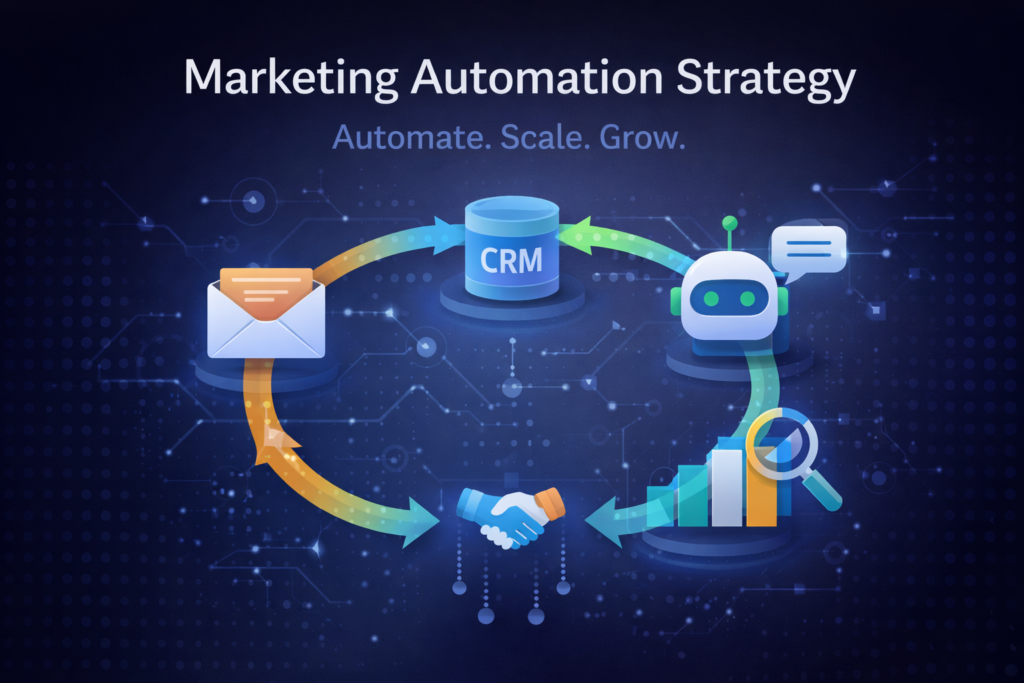
A strong marketing automation strategy solves this by turning repetitive tasks into automated systems that work 24/7.
What Is a Marketing Automation Strategy
A marketing automation strategy is a structured approach to automating marketing tasks such as lead nurturing, follow-ups, and customer communication.
Instead of manually managing every interaction, automation tools handle the process based on predefined actions and triggers.
This allows businesses to:
- Save time
- Improve efficiency
- Increase conversions
- Scale faster
Why Marketing Automation Is Essential for Scaling
As your business grows, managing leads manually becomes impossible.
Without automation, you face:
- Delayed responses
- Lost leads
- Inconsistent communication
- High operational workload
With automation, you get:
- Instant responses
- Better lead management
- Consistent follow-ups
- Scalable systems
Key Areas Where Automation Drives Growth
1. Lead Capture and Qualification
Automation helps capture and qualify leads instantly.
Examples:
- Forms with auto-responses
- Lead scoring systems
- Instant CRM entry
This ensures no lead is missed.
2. Email Marketing Automation
Email sequences nurture leads automatically.
Common flows:
- Welcome emails
- Follow-up sequences
- Promotional campaigns
This keeps your audience engaged without manual effort.
3. CRM and Lead Management
A CRM system organizes and tracks leads.
Automation helps:
- Assign leads
- Track interactions
- Manage pipelines
This improves efficiency and conversion rates.
4. WhatsApp and Messaging Automation
Messaging platforms can automate:
- Instant replies
- Follow-ups
- Appointment confirmations
This is especially powerful for service businesses.
5. Sales Funnel Automation
Automation connects your entire funnel.
From lead capture to conversion, every step can be streamlined.
This creates a smooth and consistent customer journey.
Step-by-Step Marketing Automation Strategy
Step 1: Map Your Customer Journey
Understand how your customers move from:
- Awareness
- Interest
- Conversion
Identify where automation can be applied.
Step 2: Choose the Right Tools
Select tools for:
- CRM
- Email marketing
- Messaging automation
- Analytics
Keep your system simple and integrated.
Step 3: Automate Lead Capture
Set up:
- Forms with instant responses
- Landing pages
- Lead tracking
Ensure every lead enters your system automatically.
Step 4: Create Follow-Up Sequences
Design automated flows such as:
- Email sequences
- WhatsApp messages
- Retargeting ads
Consistency is key.
Step 5: Implement Lead Scoring
Prioritize high-quality leads based on:
- Behavior
- Engagement
- Demographics
This helps your team focus on the right prospects.
Step 6: Track and Optimize
Monitor performance using:
- Conversion rates
- Open rates
- Lead quality
Optimize continuously for better results.
Example of an Automated Growth System
A service business implemented:
- Lead capture forms
- CRM automation
- Email follow-ups
- WhatsApp automation
Result:
- Faster response time
- Higher conversion rates
- Reduced manual workload
- Scalable growth
Common Automation Mistakes
Avoid these mistakes:
- Overcomplicating systems
- No personalization
- Ignoring follow-up timing
- Using too many tools
- Not tracking performance
Keep automation simple and effective.
How Automation Helps You Scale
With a strong system in place:
- Leads are handled automatically
- Follow-ups happen instantly
- Sales processes become efficient
- Growth becomes predictable
This allows you to scale without increasing workload.
- https://themvcagency.com/operations-optimization-automation/
- https://themvcagency.com/email-marketing-automation/
- https://themvcagency.com/conversion-rate-optimization/
Conclusion
A well-defined marketing automation strategy is essential for scaling any modern business.
It allows you to handle more leads, improve efficiency, and increase conversions without adding extra workload.
Businesses that implement automation early gain a strong competitive advantage and grow faster.
FAQ Section
What is marketing automation
It is the use of tools and systems to automate marketing tasks and processes.
How does automation help scaling
It reduces manual work, improves efficiency, and allows businesses to handle more leads.
Which businesses should use automation
All service and online businesses can benefit from automation systems.
Is marketing automation expensive
It can be cost-effective when implemented correctly, especially compared to manual processes.